
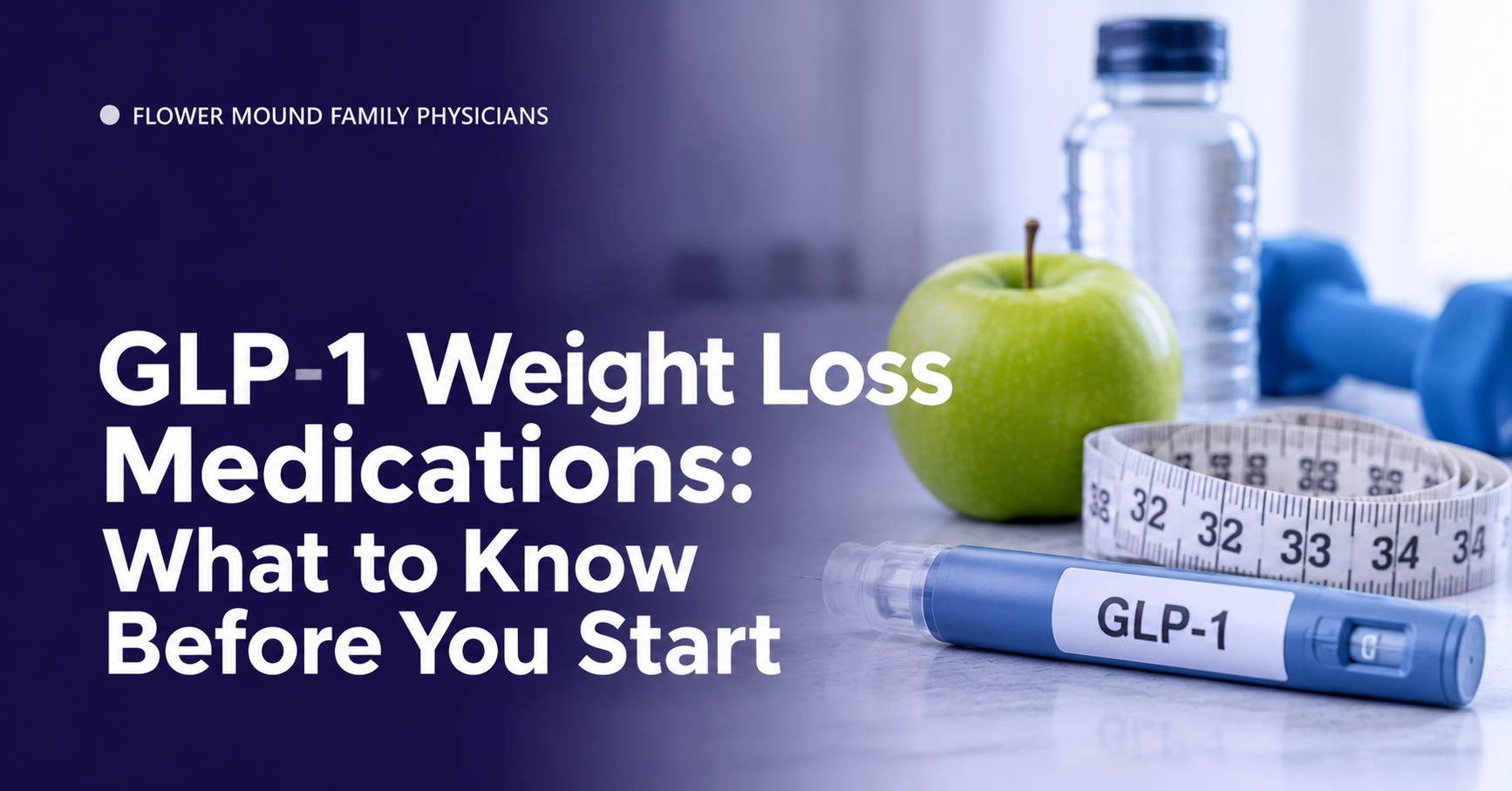

GLP-1 Weight Loss Medications: What to Know Before You Start
Medically reviewed by Dr. [Malick / Wan], Flower Mound Family Physicians · Updated November 2026
Wegovy, Zepbound, Ozempic, and now daily weight loss pills: GLP-1 medications are everywhere, and so are ads promising fast results. If you’re thinking about trying one, you probably have practical questions. Do I qualify? Which one is better? What are the side effects? What will it cost, and what happens if I stop?
This guide answers those questions in plain language, from a family medicine perspective. GLP-1 medications can be life-changing for the right person, but they work best as part of a supervised plan, not as a quick fix ordered from a website.
Quick answer: GLP-1 weight loss medications are prescription drugs that mimic gut hormones to reduce appetite and help you feel full sooner. FDA-approved options for weight loss include Wegovy (injection or pill), Zepbound (injection) and Foundayo (pill). They’re generally for adults with a BMI of 30 or higher, or 27 or higher with a weight-related health condition. Most people lose roughly 12% to 20% of their body weight over about a year and a half, depending on the medicine, but weight usually returns if treatment stops.
What Are GLP-1 Medications and How Do They Work?
GLP-1 (glucagon-like peptide-1) is a hormone your gut releases after you eat. It’s one of the incretin hormones that help regulate blood sugar and appetite. GLP-1 receptor agonists are medicines that copy this hormone, only much longer-lasting. They work in three main ways:
- They quiet hunger signals in the brain, so you feel less driven to eat and think about food less (many patients describe less “food noise”).
- They slow stomach emptying, so meals keep you full longer.
- They help the pancreas release insulin when blood sugar rises, which is why these drugs were first developed for type 2 diabetes.
Tirzepatide (Zepbound, Mounjaro) is a little different: it activates both the GLP-1 receptor and a second incretin receptor called GIP. That dual action is one reason it tends to produce more weight loss.
Ozempic vs Wegovy, Mounjaro vs Zepbound: same drug, different label
This confuses a lot of people. Ozempic and Wegovy both contain semaglutide; Mounjaro and Zepbound both contain tirzepatide. Ozempic and Mounjaro are FDA-approved for type 2 diabetes. Wegovy and Zepbound are the versions approved for chronic weight management, at doses designed for weight loss. That distinction matters for both dosing and insurance coverage.
FDA-Approved GLP-1 Medications for Weight Loss (2026)
The options changed a lot over the past year with the arrival of two daily pills. As of November 2026, these are the main GLP-1 medications approved for weight management in adults:
Medication | Active ingredient | How it’s taken | Avg. weight loss in key trial |
Wegovy (injection) | Semaglutide | Once a week | 13.7% at 72 wks (SURMOUNT-5) |
Zepbound (injection) | Tirzepatide (GLP-1 + GIP) | Once a week | 20.2% at 72 wks (SURMOUNT-5) |
Wegovy pill | Semaglutide (oral, 25 mg) | Once a day, empty stomach | 13.6%–16.6% at 64 wks (OASIS 4) |
Foundayo | Orforglipron (oral) | Once a day, any time, no food rules | Up to 12.4% at 72 wks (ATTAIN-1) |
Saxenda (older option) | Liraglutide | Once a day injection | Less than newer options |
Trial results are averages and differ by study design, dose, and how long people stayed on treatment. Your results may be higher or lower.
The Wegovy pill was approved in December 2025 as the first oral GLP-1 for obesity, and Lilly’s Foundayo (orforglipron) followed on April 1, 2026. Foundayo can be taken any time of day without food or water restrictions, while the Wegovy pill has to be taken on an empty stomach.
Semaglutide vs Tirzepatide: Which Works Better?
The best direct evidence comes from the SURMOUNT-5 trial, published in the New England Journal of Medicine, which compared the two head-to-head in 751 adults with obesity but without diabetes. After 72 weeks:
- People on tirzepatide (Zepbound) lost an average of 2% of their body weight (about 50 pounds).
- People on semaglutide (Wegovy) lost an average of 7% (about 33 pounds).
- Nearly one in three on tirzepatide lost 25% or more of their weight, compared with about one in six on semaglutide.
So on average, tirzepatide produces more weight loss. But “better” depends on you. We also consider your other health conditions, how you tolerate side effects, your insurance coverage, whether you’d rather take a pill than an injection, and cost. Semaglutide, for example, also has an FDA approval for lowering heart attack and stroke risk in people with heart disease, and tirzepatide is approved for obstructive sleep apnea in people with obesity.
Who Qualifies for GLP-1 Weight Loss Medication?
For the weight-management versions (Wegovy, Zepbound, Foundayo), FDA labeling covers adults who have:
- A BMI of 30 or higher (obesity), or
- A BMI of 27 or higher (overweight) plus at least one weight-related condition, such as high blood pressure, type 2 diabetes, prediabetes, high cholesterol, sleep apnea, or heart disease.
Not sure of your BMI? You can check it with the CDC adult BMI calculator. BMI is only a starting point, though. At your visit we also look at waist size, labs, blood pressure and your overall health.
Who should NOT take a GLP-1
These medications aren’t right for everyone. Your doctor will usually avoid them if you:
- Have a personal or family history of medullary thyroid cancer or MEN 2 (multiple endocrine neoplasia type 2)
- Are pregnant, trying to get pregnant, or breastfeeding
- Have had pancreatitis, or have certain serious stomach or gallbladder problems
- Have type 1 diabetes, or are taking another GLP-1 product
GLP-1 Side Effects and Safety
Common side effects
Most side effects involve the digestive system, are mild to moderate, and are worst when you start or raise the dose. They include:
- Nausea (the most common), sometimes vomiting
- Diarrhea or constipation
- Heartburn, burping, bloating or stomach pain
- Fatigue, and injection-site redness for the shots
This is why doses start low and increase slowly over several months. Eating smaller meals, stopping when you feel full, cutting back on greasy foods and drinking enough water all help a lot.
Less common but serious risks
- Thyroid C-cell tumors: these drugs carry a boxed warning because they caused thyroid tumors in rodents. It’s not known whether this happens in humans, but people with the history above shouldn’t use them.
- Pancreatitis: severe, persistent belly pain that may spread to the back needs prompt medical attention.
- Gallbladder problems: rapid weight loss of any kind raises the risk of gallstones.
- Low blood sugar, mainly if you also take insulin or a sulfonylurea
- Dehydration and kidney strain from vomiting or diarrhea
- Muscle loss: some of the weight you lose can be lean muscle, especially if you don’t eat enough protein or stay active
Regular check-ins with a doctor are how these risks are caught early, and that’s one of the biggest differences between supervised care and an online prescription.
Getting the Most From GLP-1 Treatment
The medication makes it easier to eat less, but what you eat and how you move still matter, especially for keeping muscle and keeping weight off. The approved labels all say these drugs are meant to be used alongside a reduced-calorie diet and more physical activity.
- Prioritize protein at every meal to help protect muscle while you lose fat.
- Add strength training two to three times a week, even simple bodyweight exercises.
- Eat smaller, slower meals and stop at the first sign of fullness to limit nausea.
- Stay hydrated and include fiber to help with constipation.
Our Healthier Eating Habits guide is a good place to start building meals that work with your medication.
How Much Do GLP-1 Medications Cost?
Prices have dropped sharply in the last year, but they still vary a lot depending on your coverage. Here’s the picture as of November 2026 (always confirm current prices before you fill):
How you pay | What to expect |
Commercial insurance | Coverage for weight loss varies widely. Many plans require prior authorization with your BMI and health conditions; some employer plans exclude weight loss drugs entirely. |
Self-pay (manufacturer programs) | Wegovy pill and Foundayo start at about $149/month at the lowest dose. Zepbound runs about $299–$449/month depending on dose. The Wegovy pen is about $349/month after starter pricing. |
Medicare | Since July 1, 2026, the Medicare GLP-1 Bridge lets eligible Part D members get Wegovy (pen or pill), Foundayo or the Zepbound KwikPen for a $50/month copay, through Dec 31, 2027. |
Compounded versions | Not FDA-approved. See below. |
Medicare GLP-1 Bridge: who qualifies
To qualify for the $50 copay you need Medicare Part D (or a Medicare Advantage drug plan) and, when you started GLP-1 therapy, one of the following: a BMI of 35 or higher; a BMI of 30 or higher with heart failure (preserved ejection fraction), uncontrolled high blood pressure on two medications, or stage 3a+ kidney disease; or a BMI of 27 or higher with prediabetes, a prior heart attack or stroke, or symptomatic peripheral artery disease. Note that the $50 copay doesn’t count toward your Part D out-of-pocket cap. We can help check whether you qualify.
A word about compounded semaglutide and tirzepatide
During the drug shortages of 2022–2025, compounded copies were widely sold. Those shortages are over, and the FDA has stepped up enforcement. Compounded GLP-1s are not FDA-approved, so their safety, strength and quality haven’t been reviewed the same way. As of May 2026, the FDA had received more than 1,700 adverse event reports tied to compounded semaglutide and tirzepatide, including dosing errors, and has sent warning letters to dozens of telehealth companies for implying their products were the same as the brand-name drugs. With brand-name self-pay prices now much lower, we recommend FDA-approved medications. Learn more from the FDA on the risks of compounded drugs.
What Happens When You Stop Taking a GLP-1?
This is the question most ads skip. Obesity behaves like a chronic condition, much like high blood pressure: when the treatment stops, the underlying biology comes back. Studies show it clearly:
- In the STEP 1 extension study, people who stopped semaglutide regained about two-thirds of the weight they had lost within a year, and improvements in blood pressure and blood sugar faded too.
- In the SURMOUNT-4 trial, people switched from tirzepatide to placebo regained about 14% of their body weight over a year, while those who continued kept losing.
That doesn’t mean you’re locked in forever. It means stopping should be a planned decision with your doctor: tapering, building strong eating and exercise habits first, and sometimes moving to a lower maintenance dose. A GLP-1 is a tool, and how you use it over the long term matters as much as how you start.
Physician-Guided GLP-1 Weight Loss in Flower Mound
Med spas and online sellers can get you a prescription fast. What they usually can’t do is look at the whole picture. Through our Medical Weight Loss Program, your care at Flower Mound Family Physicians includes:
- A full evaluation: your weight history, BMI, medications, family history and goals
- Baseline labs through our in-house lab testing: A1C, cholesterol, kidney and liver function, and thyroid as needed
- Choosing the right medication (injection or pill, semaglutide or tirzepatide) based on your health, preferences and coverage
- Help with insurance, prior authorizations and the Medicare GLP-1 Bridge
- Slow, safe dose increases with regular check-ins to manage side effects
- Nutrition and activity guidance focused on protein, strength and habits that last
- Care for related conditions like blood pressure, prediabetes, diabetes and sleep apnea through our chronic conditions services
- A long-term plan, including what maintenance or stopping looks like for you
Frequently Asked Questions
How much weight can you lose on a GLP-1?
Is Zepbound better than Wegovy?
Are GLP-1 weight loss pills as effective as injections?
What are the most common GLP-1 side effects?
Who should not take GLP-1 medications?
Will I gain the weight back if I stop?
Does Medicare cover GLP-1s for weight loss?
Is compounded semaglutide safe?
Ready to find out if a GLP-1 is right for you?
Our doctors will review your health, explain your options honestly, and build a plan that fits your life, whether or not medication is part of it.
Book a weight loss consultation →
Flower Mound Family Physicians · 2609 Sagebrush Dr, Ste 101, Flower Mound, TX 75028 · (972) 539-4875