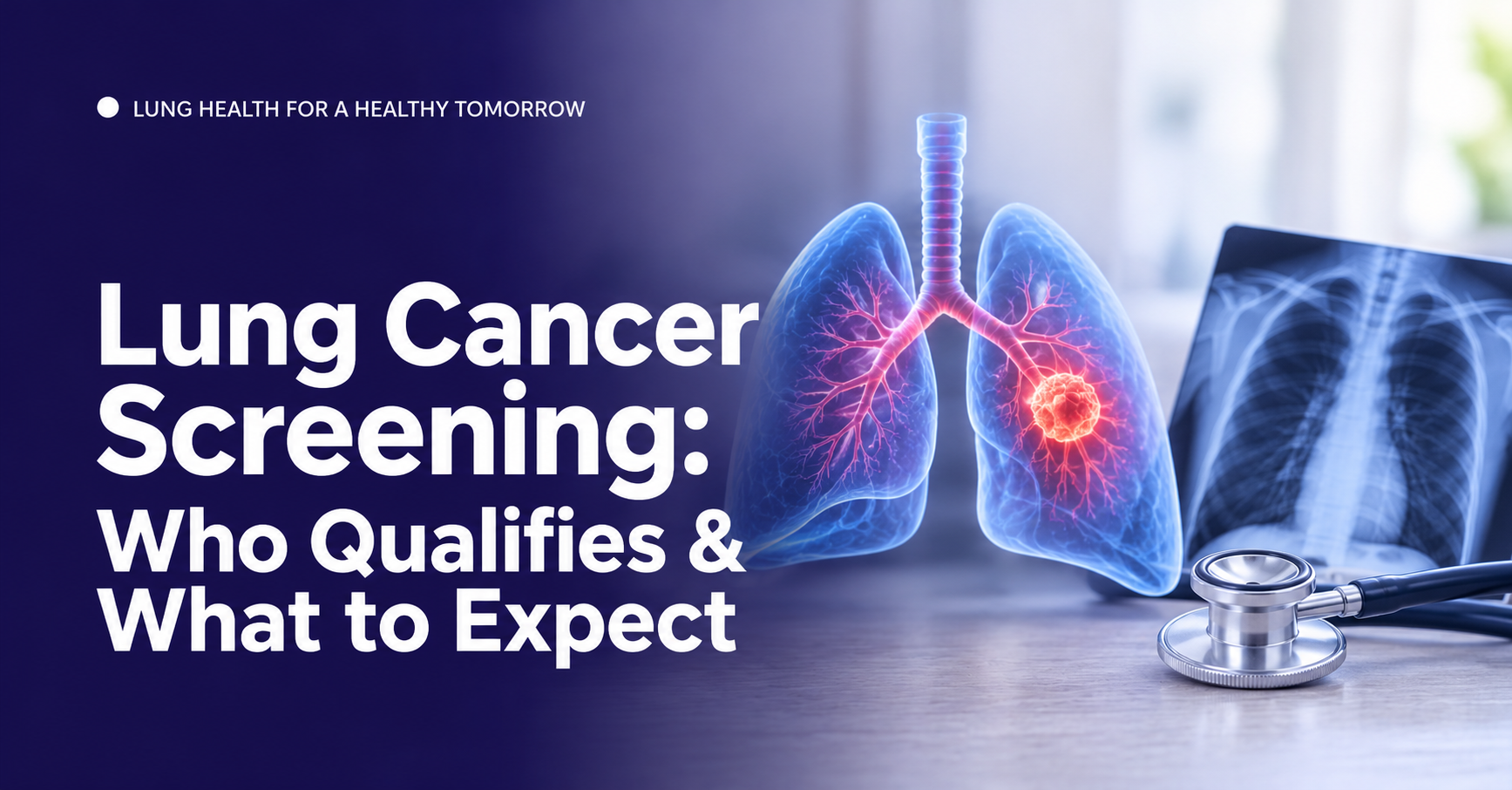

Lung Cancer Screening: Who Qualifies and What a Low-Dose CT Involves
If you smoked for years, even if you quit a long time ago, there is a simple yearly test that can find lung cancer early, often before you’d notice any symptoms. It’s called a low-dose CT scan, it takes less than a minute, and most insurance plans cover it at no cost if you qualify.
The trouble is that very few people who qualify actually get it. Nationally, only about 18% of high-risk adults were screened, and Texas ranks 46th in the country at just 12%, according to the American Lung Association’s 2025 State of Lung Cancer report. November is Lung Cancer Awareness Month, and the Great American Smokeout is Thursday, November 19, so it’s a good moment to find out where you stand.
This guide walks through who qualifies, how to count your pack-years, what the scan is actually like, and what happens after.
Why Screen for Lung Cancer at All?
Lung cancer is the leading cause of cancer death in the United States, largely because it usually causes no symptoms until it has already spread. When it is caught early, though, the picture changes a lot: early-stage lung cancer is far more treatable, and often curable with surgery.
That’s what screening is for. In the National Lung Screening Trial, a large study of more than 53,000 current and former heavy smokers, people screened with low-dose CT had 20% fewer lung cancer deaths than people screened with a standard chest X-ray. Chest X-rays are not recommended for lung cancer screening; low-dose CT is the only recommended test.
Who Should Be Screened? (Lung Cancer Screening Eligibility)
The U.S. Preventive Services Task Force (USPSTF) recommends a yearly low-dose CT scan for adults who meet all three of these:
- Age 50 to 80
- A smoking history of at least 20 pack-years (see how to count below)
- You currently smoke, or you quit within the past 15 years
Screening also assumes you have no symptoms of lung cancer and are healthy enough to have treatment, such as surgery, if something is found.
What if I quit more than 15 years ago?
This is where the guidelines differ. In 2023 the American Cancer Society dropped the “years since quitting” rule entirely. Under the ACS guideline, anyone aged 50 to 80 with a 20 pack-year history should be screened yearly, whether they quit last week or 25 years ago, because lung cancer risk keeps rising with age even after you stop.
Insurance coverage doesn’t always follow the ACS, though, so if you quit more than 15 years ago it’s worth a conversation with your doctor about your risk and your plan’s rules.
What about Medicare?
Medicare covers yearly lung cancer screening for people aged 50 to 77 who have a 20 pack-year history, currently smoke or quit within the last 15 years, and have no symptoms. Before your first scan, Medicare requires a short counseling and shared decision-making visit with a clinician, which we do right here in the office. That visit has no coinsurance or deductible.
USPSTF (2021) | American Cancer Society (2023) | Medicare | |
Age | 50–80 | 50–80 | 50–77 |
Smoking history | 20+ pack-years | 20+ pack-years | 20+ pack-years |
If you quit | Within past 15 years | Any time | Within past 15 years |
How often | Every year | Every year | Every year |
How to Count Pack-Years (With Examples)
A “pack-year” is a way of measuring how much you’ve smoked over your lifetime. The formula is simple:
Packs per day × Number of years smoked = Pack-years
One pack is 20 cigarettes. A few examples:
Smoking history | Calculation | Pack-years | Meets 20+? |
1 pack a day for 20 years | 1 × 20 | 20 | Yes |
2 packs a day for 10 years | 2 × 10 | 20 | Yes |
½ pack a day for 30 years | 0.5 × 30 | 15 | No |
1½ packs a day for 25 years | 1.5 × 25 | 37.5 | Yes |
A worked example: Linda is 62. She smoked about a pack a day from age 20 to 35, cut back to half a pack from 35 to 50, then quit at 50. Her history adds up in two pieces: (1 × 15) + (0.5 × 15) = 15 + 7.5 = 22.5 pack-years. She quit 12 years ago, so Linda qualifies for yearly screening under every guideline above.
If your smoking went up and down over the years, add up each stretch separately the same way. A best estimate is fine. If you’re unsure, bring your rough history to your visit and we’ll work it out together.
What a Low-Dose CT Scan Is Like
If you’ve been putting off screening because you’re picturing something unpleasant, the reality is easy:
- No needles, no dye, no fasting. You don’t need any prep.
- It’s fast. You lie on your back on a table that slides through a large, open, ring-shaped scanner and hold your breath for a few seconds. The scan itself takes under a minute; the whole appointment is usually 10 to 15 minutes.
- It doesn’t hurt. You may be asked to remove jewelry and anything metal on your upper body.
- It’s low dose. The scan uses much less radiation than a regular diagnostic CT. In the national trial, the average dose was about 1.5 mSv, roughly what you’d pick up from natural background radiation over six months.
The scan is done at an accredited imaging center. We place the order, help you schedule it, and get the results back to review with you.
Results, Follow-Up and False Positives
Radiologists report lung screening results using a standard system called Lung-RADS, which sorts findings into categories and tells your doctor what to do next. In plain terms:
- Normal or clearly benign findings (most people): come back in a year for your next scan.
- Probably benign: a short-interval follow-up scan, often in 6 months, to make sure nothing has changed.
- Suspicious: further testing, such as a sooner repeat CT, a PET scan, or a referral to a lung specialist.
About false positives
It’s very common for a scan to show a small spot (a nodule) on the lung, and the vast majority are not cancer. They are usually old scars, tiny lymph nodes, or healed infections. In the national trial, about 96% of positive results turned out not to be cancer, and most were confirmed harmless simply by a follow-up scan showing no change.
We tell you this up front because a “something was found” call can be scary, and knowing the odds helps. Other potential downsides worth discussing are follow-up procedures that turn out to be unnecessary and finding slow-growing cancers that might never have caused harm. These are part of the shared decision-making conversation we have before your first scan.
Screening is yearly, not one-and-done
The benefit of screening comes from doing it every year. A clear scan this year doesn’t cover you for the next five. We’ll set a reminder so you don’t have to keep track.
Quitting Smoking: What Actually Helps
Screening finds cancer early, but quitting is the single best way to lower your risk of lung cancer, heart disease, stroke and COPD. And it’s never too late: your risk starts to drop the day you stop.
If you’ve tried before and it didn’t stick, you’re not alone. Most people need several attempts. What makes the biggest difference is using support and medication together; that combination roughly doubles your chances of quitting for good. Options include:
- Nicotine replacement (patch, gum, lozenge), often combined, like a patch plus gum for cravings
- Prescription medications such as varenicline or bupropion
- Coaching and a quit plan: setting a date, knowing your triggers, and planning for the tough moments
- The free Texas Tobacco Quitline: call 1-877-YES-QUIT (1-877-937-7848) or visit org for free, confidential coaching in English and Spanish, plus up to two weeks of nicotine replacement for eligible Texans
The Great American Smokeout (Thursday, November 19) is a great day to quit, or to set your quit date. Our doctors can help you build a plan, prescribe medication if it’s right for you, and follow up so you’re not doing it alone.
Getting Screened Through Your Primary Care Doctor in Flower Mound
Your family doctor is the easiest starting point for lung cancer screening because we already know your health history. At Flower Mound Family Physicians, we can:
- Check your eligibility and calculate your pack-years with you
- Hold the shared decision-making visit required by Medicare and many insurers, and answer your questions about benefits and risks
- Order your low-dose CT at a trusted local imaging center
- Review your results with you and coordinate any follow-up
- Help you quit smoking with medication, coaching and check-ins
If you also have COPD, high blood pressure or diabetes, we can manage those at the same time through our Treatment of Chronic Medical Conditions services. And if you’re keeping up with other screenings, see our posts on prostate and ovarian cancer awareness and skin cancer.
Frequently Asked Questions
Who qualifies for lung cancer screening?
How do I calculate pack-years?
Is a low-dose CT scan safe?
Does insurance cover lung cancer screening?
How often should I get screened?
What if my scan finds a nodule?
I never smoked but I'm worried. Should I be screened?
I never smoked but I’m worried. Should I be screened?
Routine screening isn’t recommended for people who have never smoked, because the benefits don’t outweigh the risks for them. If you have symptoms like a cough that won’t go away, coughing up blood, or unexplained weight loss, see your doctor. That’s a different situation from screening.
Not sure if you qualify?
Book a visit and bring a rough idea of how long and how much you smoked. That’s all we need to get started.
Book an appointment →