



Why Your 40s Are the Decade to Start
Age is the biggest risk factor for breast cancer that you can’t change. About 1 in 8 women in the U.S. will be diagnosed with invasive breast cancer at some point in her life, and the large majority of those diagnoses happen after 40.
That number isn’t meant to scare you. It’s the reason screening works. A mammogram can pick up a tumor that is still too small to feel, and cancers caught at that stage usually need less treatment and have far better outcomes.
A few other things shift in this decade too:
- Perimenopause often starts. Changing estrogen and progesterone levels can make breasts feel lumpier, more tender, or different from month to month.
- Your risk picture changes. A new diagnosis in a relative, a past biopsy, or years of hormone use can all move you into a different screening group.
- Preventive care gets skipped. Women in their 40s are often the ones managing everyone else’s appointments, not their own.
What the Current Mammogram Guidelines Say
Part of the confusion is that the major medical groups don’t use exactly the same schedule. They do agree on the main point: for women at average risk, screening should be on the table starting at age 40.
|
Organization |
When to start |
How often |
|
U.S. Preventive Services Task Force (USPSTF, 2024) |
Age 40 |
Every 2 years, ages 40 to 74 |
|
American Cancer Society (ACS) |
Option at 40, recommended by 45 |
Yearly from 45 to 54; every 1 to 2 years from 55 |
|
American College of Radiology (ACR) |
Age 40, with a risk assessment by age 25 |
Every year |
|
American College of Obstetricians and Gynecologists (ACOG, 2024) |
Age 40 |
Every 1 to 2 years, through at least age 74 |
So should you go every year or every other year? That depends on your family history, your breast density, past biopsy results, and how you weigh the trade-offs, like the chance of a callback for a finding that turns out to be nothing. It’s a decision to make with your doctor, not a box on a form. Guidelines also get revised every few years, so ask at your visit what applies to you right now.
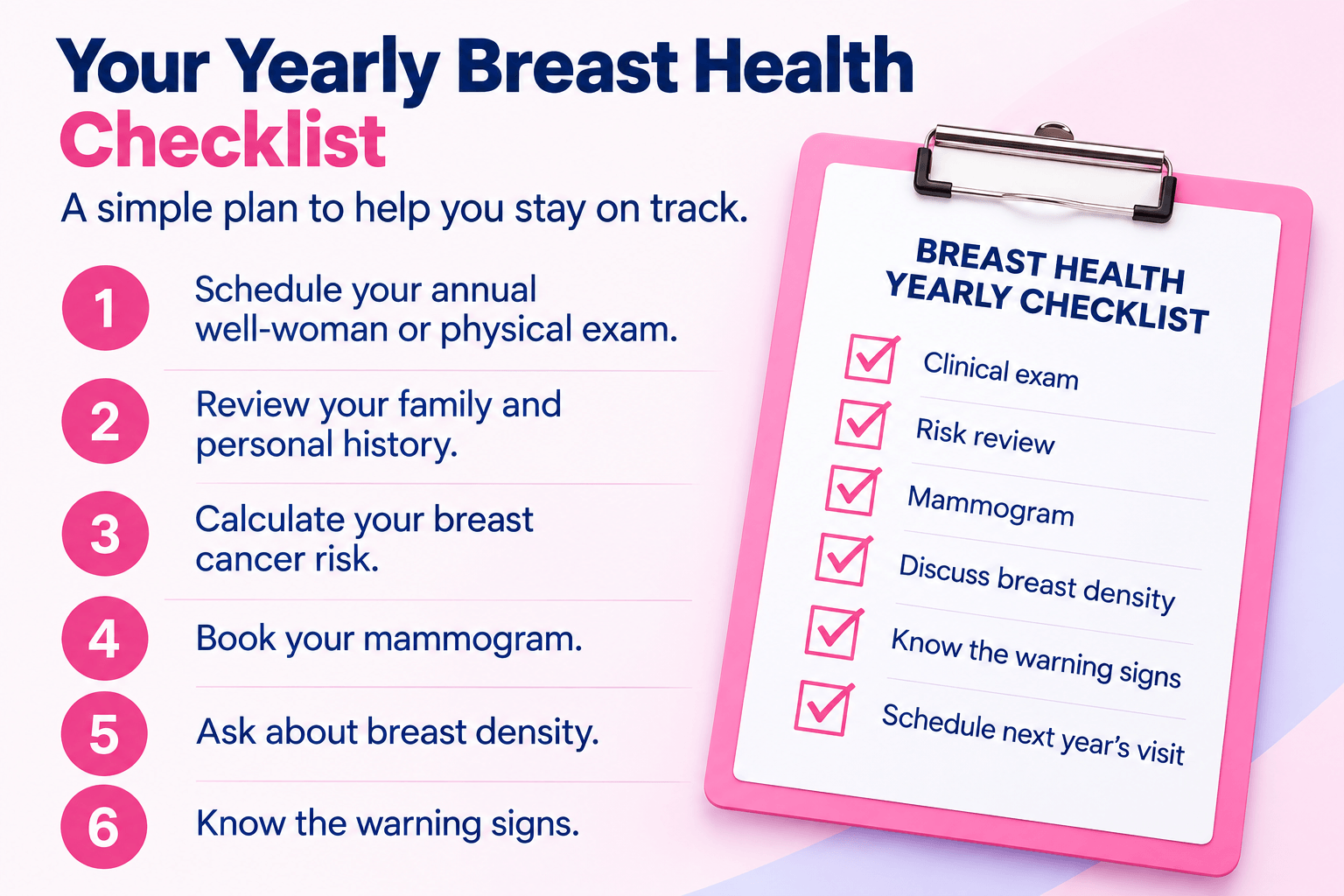
Screenshot this list or stick it on the fridge. We explain each step below.
- Book your annual physical or well-woman visit.
- Update your family and personal health history.
- Ask about your personal breast cancer risk.
- Schedule your screening mammogram.
- Find out your breast density and what it means for you.
- Check in with your breasts once a month.
- Call the office about any new change, without waiting.
- Review alcohol, activity, weight, and sleep.
- Go over hormones, birth control, and supplements.
- Book next year’s appointments before you leave.
Step 1: Start With Your Annual Physical
Your yearly visit with a family medicine doctor is where everything else gets set up. In one appointment we can review your breast health alongside blood pressure, cholesterol, thyroid, bone health, and mood, then place the order for your mammogram so you aren’t chasing a referral later.
Many physicians still include a clinical breast exam at this visit. The provider checks both breasts, the underarms, and the area around the collarbone for lumps, skin changes, or anything that looks uneven. Guidelines differ on how much a routine clinical exam adds for average-risk women, but it gives you a set time to bring up anything you’ve noticed.
What to bring:
- The date and location of your last mammogram
- Any breast changes you’ve noticed, even small ones
- New cancer diagnoses in your family since your last visit
- Your medications and supplements, including any hormone therapy
- Two or three questions written down (it’s easy to forget them once you’re in the room)
Step 2: Know Your Family History and Personal Risk
Most women diagnosed with breast cancer have no close relative with the disease. Still, family history does matter for deciding when and how you get screened. Tell your doctor if any of these apply:
- A mother, sister, or daughter with breast cancer, especially before menopause
- Relatives with ovarian, pancreatic, or prostate cancer
- A known BRCA1, BRCA2, or other inherited gene change in the family
- A past breast biopsy showing atypical cells
- Radiation to the chest before age 30
- Your first period before 12, menopause after 55, or a first pregnancy after 30 (or no pregnancies)
Your provider may run a risk assessment tool. Women with an estimated lifetime risk of 20% or higher are usually advised to start earlier, add a yearly breast MRI, or meet with a genetic counselor. Women who carry certain gene mutations follow a separate schedule entirely.
Step 3: Schedule Your Mammogram After 40
A screening mammogram is a low-dose X-ray of each breast. It takes about 20 minutes, and the compression part lasts only a few seconds per image. It can be uncomfortable. It shouldn’t be painful, so tell the technologist if it is.
A few things that make the day easier:
- Book it for the week after your period, when breasts are usually less tender.
- Skip deodorant, powder, and lotion that morning. Some contain particles that show up on the images.
- Wear a top and pants or a skirt so you only change from the waist up.
- Go back to the same imaging center each year if you can. Radiologists rely on comparing this year’s images to past ones.
- Ask whether they offer 3D mammography (tomosynthesis), which can help in women with dense tissue.
If you get a callback: it happens to roughly 1 in 10 women, and the large majority of callbacks turn out to be normal tissue, a cyst, or something benign. Go to the follow-up promptly, but try not to assume the worst while you wait.
About cost: under the Affordable Care Act, most private plans cover screening mammograms for women 40 and older with no copay. Starting with 2026 plan years, updated federal women’s preventive guidelines also call for coverage of follow-up imaging or a biopsy needed to finish the screening process. Coverage still varies by plan, so a quick call to your insurer is worth it.
Step 4: Find Out If You Have Dense Breasts
Breast density describes how much fibrous and glandular tissue you have compared to fatty tissue. It’s something a radiologist sees on your mammogram. You can’t tell by how your breasts feel.
It matters for two reasons. Dense tissue looks white on a mammogram, and so do tumors, which can make a cancer harder to spot. Dense breasts are also linked to a modestly higher risk of breast cancer. Close to half of women 40 and older have dense breasts, so this is common, not a problem in itself.
Since September 2024, an FDA rule requires every mammography facility in the U.S. to tell you whether your breasts are dense in your results letter. If yours says “dense” or “heterogeneously dense,” bring it to your next appointment. Depending on your overall risk, we may talk about a breast ultrasound or MRI in addition to your mammogram. Not everyone with dense breasts needs extra imaging.
Step 5: Practice Breast Self-Awareness Each Month
The strict, step-by-step monthly self-exam many of us were taught has given way to something simpler: breast self-awareness. The idea is to know what’s normal for you so a change stands out.
- Pick a regular day. A few days after your period ends works well. If you no longer have periods, use the first of the month.
- Look first. Stand in front of a mirror with your arms down, then raised. Watch for changes in size, shape, skin texture, or the nipple.
- Then feel. Use the flat pads of your fingers with light, medium, and firm pressure. Cover the whole area from collarbone to bra line and from armpit to breastbone.
- Use whatever position is easiest. Some women like soapy fingers in the shower; others find it easier lying down.
- Write it down. If something feels new, note the date and where it is. That detail helps a lot at your appointment.
Most lumps are not cancer. But you can’t tell the difference by touch, so anything new that sticks around past your next cycle should be checked.
Breast Changes That Shouldn’t Wait for Your Next Screening
A normal mammogram last year doesn’t cover a new symptom this year. Screening mammograms are meant for women without symptoms. If you notice any of these, call your doctor rather than waiting for your annual visit:
- A new lump or thick area in the breast or armpit
- Swelling of part or all of one breast
- Skin dimpling or puckering that looks like an orange peel
- Redness, scaling, or thickening of the skin or nipple
- A nipple that has newly turned inward
- Nipple discharge that is bloody, clear, or from only one side
- New breast pain in one spot that doesn’t go away
- A change in the size or shape of one breast
A new symptom usually calls for a diagnostic mammogram, an ultrasound, or both. For a closer look at warning signs, read our guide to 7 breast cancer symptoms every woman should know.
Daily Habits That Support Breast Health
No habit can guarantee you won’t get breast cancer. Some do lower risk, and they help your heart, bones, and energy at the same time.
Drink less alcohol. Breast cancer risk rises with every drink. Even one drink a day is linked to a small increase, so cutting back is one of the most useful changes you can make.
Stay active. The target is 150 minutes of moderate activity a week. Three 10-minute walks a day count, and that’s easier to fit in than an hour at the gym.
Keep an eye on weight after menopause. Extra body fat after menopause raises estrogen levels, which is tied to a higher risk of hormone-receptor-positive breast cancer. If you’ve been struggling here, our medical weight loss program offers physician-guided support.
Eat mostly plants. Vegetables, fruit, beans, whole grains, and healthy fats. Fewer sugary drinks and heavily processed foods.
Don’t smoke. Smoking is linked to several cancers, and some studies tie it to breast cancer too, especially when started young.
Protect your sleep. Poor sleep and constant stress don’t cause breast cancer directly, but they make every other habit on this list harder to keep.
Menopause, Hormone Therapy, and Your Breasts
Many women in their 40s and 50s consider hormone therapy for hot flashes, night sweats, poor sleep, or vaginal dryness. For a lot of them it’s a reasonable choice. Combined estrogen-plus-progestin therapy taken for several years is linked to a small rise in breast cancer risk, though, and hormones can also make breast tissue look denser on a mammogram.
Questions worth asking at your visit:
- Does hormone therapy make sense with my symptoms and risk level?
- What type, dose, and length of treatment would you suggest?
- Are there non-hormonal options I could try first?
- Will it change how often I need a mammogram?
Also mention birth control pills, fertility drugs, and supplements, since some of them affect breast tissue. Our women’s healthcare visits cover menopause care as part of your overall plan.
How to Actually Fit This Into a Busy Year
Knowing the steps is easy. Getting them done is where most of us fall short. A few things that work for our patients:
- Book next year before you leave. Schedule your physical and mammogram before you walk out of this year’s appointment.
- Tie it to a date you already remember. Your birthday month is popular. Breast Cancer Awareness Month in October works too.
- Set a repeating phone reminder for the first of each month as your self-awareness check.
- Ask for early-morning or lunch-hour slots. Many imaging centers offer them, so ask when you call.
- Go with a friend. Book mammograms back to back with a sister or a friend and get coffee afterward.
- Keep your reports in one place. A phone folder with each year’s mammogram letter makes comparing results easy.
Breast Health Care in Flower Mound, TX
The most useful step on this list is the first one: have a primary care doctor who knows your history and keeps track of what’s due.
At Flower Mound Family Physicians, Dr. Nazia Malick and Dr. Li Wan see women from Flower Mound, Highland Village, Lewisville, Argyle, and nearby communities for annual physicals, preventive screenings, and women’s health care. We’ll review your risk, order your mammogram, explain your density results, and follow up on anything that needs a second look.