




In general terms, discussions on PTSD revolve around anxiety and flashbacks, but it is more than an emotional struggle.
PTSD is not an internal weakness or an inability to “get over” an unsettling experience. Prolonged trauma can physically alter how your brain processes danger, forcing it into a constant survival mode.
In this post, we are breaking down the science of PTSD, exploring exactly how it hijacks your nervous system, and why your body gets stuck in a permanent state of high alert.
What is PTSD?
Post-traumatic stress disorder (PTSD) refers to a mental health condition that develops following a traumatic experience. A wide range of experiences, from a fatal accident, a natural disaster, childhood abuse, and a medical emergency, could pose a threat trigger for PTSD.
It is normal to feel distressed immediately after being struck by a traumatic event. In the aftermath of danger, the human body and mind exhibit different ways of dealing with stress, such as shock, nightmares, difficulty sleeping, or a feeling that something is off-balance.
Most people gradually recover from the trauma, but if these symptoms persist for more than a month or start interfering with daily life, PTSD is the likely cause. At this point, the normal stress response has turned into a disorder mainly because the brain continues to perceive a threat to one’s survival or well-being.
According to the National Institute of Mental Health, approximately 6.8% of U.S. adults, or roughly 1 in 13 Americans, are likely to develop PTSD at some point in their lifetime.
Although PTSD is common across population segments, women are twice as prone to being diagnosed with PTSD. Moreover, it is not specifically linked to any particular type of trauma.
Types of PTSD
PTSD doesn’t look the same in everyone. It may take any of these clinical forms:
- Complex PTSD (C-PTSD): This PTSD type develops from experiencing repetitive traumatic episodes over extended periods. It is often rooted in an interpersonal conflict such as childhood abuse or domestic violence. The individual may exhibit core PTSD symptoms plus additional difficulties with emotional regulation, self-image, and relationships.
- Dissociative PTSD: A person with dissociative PTSD feels standard PTSD symptoms along with feeling detached from one’s body or having illusions about the real world.
- PTSD with delayed expression: A diagnosis of PTSD requires symptoms to continue for a minimum of 6 months after the traumatic event, even if some symptoms appeared earlier.
- Childhood PTSD: PTSD in children differs from its clinical presentation in adults. Factors such as abuse, accidents, or disasters can produce extreme stress in children, leading to symptoms such as re-experiencing the trauma, behavioral changes like increased anxiety and irritability, and physical complaints like headaches or stomachaches without an obvious medical cause.
The Four Groups Of PTSD Symptoms Explained
PTSD symptoms are generally diagnosed using DSM-5, a diagnostic tool that classifies them into 4 different categories. Each subtype signifies specific changes at the level of the brain and the nervous system.
1. Intrusion symptoms
The traumatic memory can spill over into daily life beyond individual control. The person may get flashbacks as if they are reliving the event again, along with nightmares and unconsciously recalling the event.
Intrusion symptoms reflect improperly stored memories that continue to linger on in a person’s consciousness, disrupting regular life.
2. Avoidance symptoms
A person with PTSD feels an obsessive urge to avoid anything that might trigger the traumatic memory. This includes not just where the trauma first occurred, people, activities, conversations, but also internal thoughts and feelings.
These avoidance tactics temporarily reduce distress but prevent the brain from processing and filing away the traumatic memory. This keeps PTSD locked in place.
3. Changes in thinking and mood
PTSD can leave one with persistent negative beliefs about oneself or the world, such as “I am damaged,” or ‘’nowhere is safe’’. The individual may blame others, become emotionally numb, or lose interest in day to day activities.
These negative feelings occur because the brain’s centre for regulating emotions becomes suppressed, with specifically reduced activity in the prefrontal cortex.
4. Changes in arousal and reactivity
When someone lives with trauma or chronic stress, they remain in a particular state of Hypervigilance or a threat mode. Due to this, they are constantly on guard, easily startled at the slightest trigger, or struggle with sudden bursts of anger. Their brain has essentially reset its baseline to stay ready for a threat, even when you are safe.
Beyond fight-or-flight: freeze and fawn
In the face of danger, the body relies on the fight-or-flight mechanism, where it may either confront it or escape. The nervous system displays a more varied response, involving the dorsal vagal branch of the parasympathetic nervous system.
While the sympathetic response is oriented toward some type of physical response, the nervous system goes into freeze mode. The body’s internal systems shut down entirely so that the heart rate drops, the muscles stiffen, and the mind dissociates from the source of trauma.
This explains why some people with PTSD feel paralysed, disconnected, or numb rather than anxious and activated.
An alternative response may also be evoked mainly to avoid conflict that may involve pleasing people or displaying complaint behavior. This is especially seen in people who had no concrete means of escaping danger in the face of interpersonal trauma.
How PTSD changes the brain
The results from Brain imaging studies have shown that PTSD can induce measurable changes to three key brain regions. MRI scans are a key diagnostic tool to reveal what organs are affected and why these symptoms originate.
The Amygdala
The amygdala is a small, almond-shaped structure located deep within the brain that detects threats and triggers the fear response. It works as a smoke alarm that goes off when a threat approaches and gets silent once the threat is over.
In PTSD, the amygdala becomes so sensitized that it sends alarm signals on encountering stimuli associated with the previous experience. The amygdala may be triggered by something as innocent as a scent or a high-pitched voice and launch a full-scale physiological stress response. This can spike the heart rate, lead to rapid breathing, or arouse a surge in adrenaline levels.
Research has indicated that PTSD and a hyperactive amygdala are closely related, which makes it react to irrational triggers that it imagines to be real.
The Hippocampus
The hippocampus is the part of the brain that forms and organises memories. Not only does it encode what happened in the past, but it also provides a context to explain why, where, and when a given episode first happened.
Exposure to severe and prolonged stress can cause a rapid rise in cortisol and other stress-regulating hormones that damage the hippocampal neurons. People with PTSD have been found to exhibit lower volumes of hippocampal hormones compared to those without PTSD.
This significantly impacts the hippocampus’s ability to contextualise memory and label it as a past event. The memory remains fragmented and unsteady, so that an individual feels as if it’s happening now rather than a figment from the past.
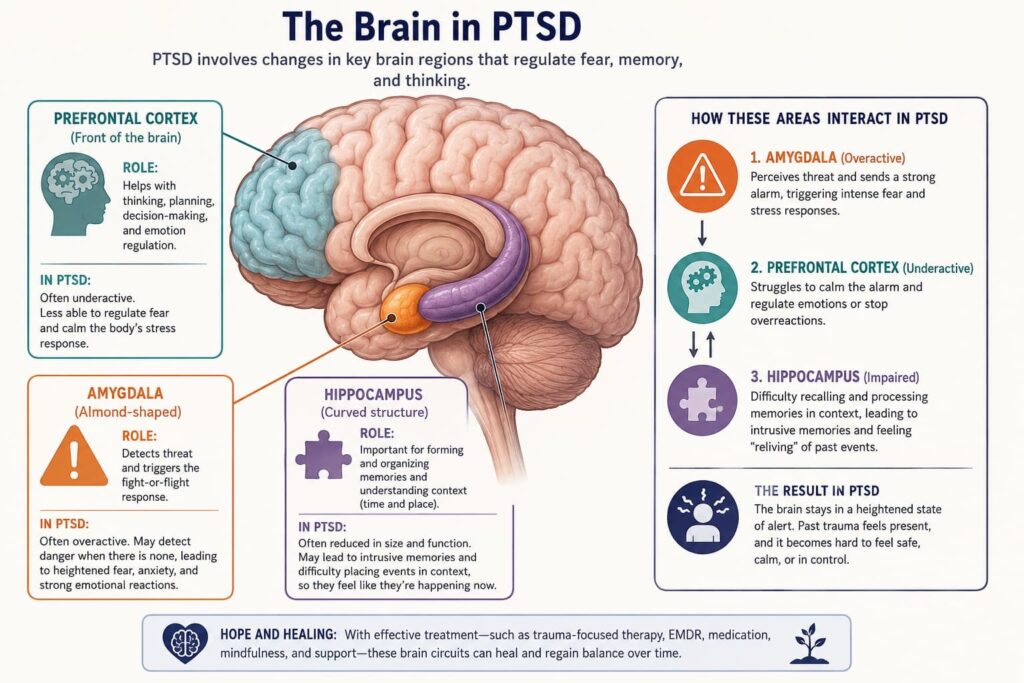
Illustration of the brain highlighting the amygdala, hippocampus, and prefrontal cortex and their roles in PTSD
What PTSD Does To The Body’s Stress System
The HPA axis and stress hormones
The hypothalamic-pituitary-adrenal (HPA) axis acts as the body’s central stress-response system. These systems coordinate with one another to release cortisol and adrenaline when threatened. In normal situations, the HPA axis activates quickly when danger is perceived and eventually switches off when the threat passes.
In PTSD, the HPA axis becomes dysregulated. An interesting piece of research found that individuals with stress-related disorders like PTSD demonstrate lower cortisol levels, together with increased sensitivity of glucocorticoid receptors to external stimuli of threat.
The body’s threat-response system is activated despite a limited number of hormones, which makes it difficult to return to its normal baseline before the onset of stress.
HPA dysregulation in PTSD carries both physical and psychological effects. Some well-documented physical symptoms include disrupted sleep patterns, elevated heart rate, immune system changes, gastrointestinal disturbances, and chronic fatigue.
The autonomic nervous system
The autonomic nervous system (ANS) is responsible for controlling automatic functions, including heart rate, breathing, and digestion. Stress response is considered an automatic function because it happens involuntarily or without conscious control.
The ANS works through two primary modes: the sympathetic system, which activates the stress response, and the parasympathetic system, which is concerned with enabling rest, digestion, and recovery.
In a healthy nervous system, these two modes work in harmony. PTSD disrupts the natural balance, leading to sympathetic dominance. This puts the body in a perpetual state of readiness even when no actual threat exists.
In PTSD, the system becomes chronically tilted toward sympathetic dominance — the body stays in a state of readiness even in the absence of threat. The result is hypervigilance, an exaggerated startle response, making it difficult to relax due to a constant threat to one’s safety.
Frequently asked questions
PTSD is a mental health condition that develops after experiencing or witnessing a traumatic event. It causes the brain’s threat-detection system to remain active long after the danger has passed, producing symptoms like flashbacks, hypervigilance, emotional numbing, and avoidance. It is not a character flaw or a sign of weakness but a neurological response to overwhelming trauma that distorts human response to danger.
Yes. PTSD doesn’t just take a mental toll but can have far-reaching effects on the autonomic nervous system and the body’s stress-hormone system. It is typically associated with a variety of physiological changes such as sleep disturbance, elevated heart rate, muscle tension, gastrointestinal problems, fatigue, headaches, and a heightened startle response.
PTSD causes measurable changes in brain structure and function, but these are not necessarily permanent. The brain’s neuroplastic ability remains unaffected, meaning it can reorganise and adapt. Effective treatment has been shown to reduce amygdala hyperreactivity, improve hippocampal and prefrontal cortex function, and shift the nervous system toward a healthier baseline.
PTSD usually originates from a singular traumatic event or after a brief period of trauma, whereas Complex PTSD (C-PTSD) arises from extended, recurring trauma. This may involve interpersonal damage such as childhood mistreatment, domestic abuse, or extended imprisonment. Alongside primary PTSD symptoms, C-PTSD can create additional challenges related to emotional control, self-identity, and interpersonal relationships.
PTSD may continue for years or even decades if left unaddressed. While less severe forms of PTSD may heal with sufficient social support, it can assume a chronic nature if not given proper medical attention. As per the WHO, nearly 40% of individuals with PTSD recover within a year when trauma-focused therapy is utilized as part of the treatment process.
The bottom line
PTSD is not an inevitable consequence of trauma, nor a sign of inner weakness. It is a real neurological condition where the body and nervous system react overwhelmingly to a certain traumatic event that borders on suffering.
Getting the right PTSD treatment can really change how your body reacts to trauma and help you start to heal. If you understand what PTSD is and how it can affect your brain and nervous system, it can actually lower your risk and help you recover.
PTSD can make you feel isolated, but you do not have to navigate the path to healing alone.
Take the first step toward reclaiming your well-being today. Schedule a confidential consultation with a Flower Mound specialist or call us at 972-539-4875 to learn about our trauma-focused therapy options.
Medical disclaimer: This article is intended for general informational purposes only and does not constitute medical advice. If you believe you or someone you know may have PTSD, please consult a qualified healthcare professional for a proper assessment and individualised guidance.